
AI-Assisted Compliance Tooling, Built Around Your Governance
We provide standalone AI-assisted software that takes a large part of the manual work out of due diligence. The software brings together several specific use cases. It can handle OSINT research, draft CDD reviews, analyse source of income documentation, screen sanctions and watchlists, identify PEPs, monitor adverse media and much more. AI does the research and preparation. Your compliance officers remain responsible for the review and final decision. The software can be configured around the modules, risk criteria and report formats your organisation needs. It can operate as a standalone application, without requiring you to replace your existing case-management or core systems.
OSINT sources available
Sanctions and watchlists screened
Languages for media screening
Required before every final decision
*Exact coverage depends on the selected modules, data sources, configuration and availability of the underlying information.
Private Deployment Options
The software can be provided as a standalone application and, depending on the agreed technical configuration, can be deployed within your own server or private cloud environment. This gives organisations greater control over client information, uploaded documents and generated reports. The exact architecture, data flows and any external processing are documented during the scoping process, so you know where information is processed and stored before the software is used.
Tooling Capabilities
What the Tooling Does
The software can support different stages of a due diligence review while keeping the judgement and final decision with your compliance team.
OSINT Research
The software searches more than 500 available sources, including company registers, court records, news archives, beneficial ownership information and other public information. Work that can take an analyst hours to research manually can be brought together considerably faster. The underlying sources remain available so the analyst can check the information used.
CDD Review Writing
Once the research is complete, the software can prepare a full first draft of the CDD review. The review can follow your existing format and include the relevant findings, sources, risk assessment and recommended next steps. Instead of starting with an empty document, your analyst starts with a structured review that can be checked, amended and approved.
Source of Income Analysis
Upload documents such as bank statements, tax returns, financial statements or business valuations. The software analyses the information for consistency, possible red flags and whether it reasonably fits the customer’s stated profile. The findings are then presented in clear language for the reviewer.
Sanctions & Watchlist Screening
Screen individuals and entities against OFAC SDN, the EU Consolidated List, UN Security Council sanctions, UK OFSI and more than 60 other national and international lists. Automated matching and disambiguation can help reduce false positives while still identifying potential genuine matches for further review.
High-Risk Countries & Sectors
The software keeps track of information including FATF grey and black lists, EU high-risk third countries and relevant sector risk information. Connections with higher-risk countries or sectors can automatically be included in the review and assessed against your own risk framework.
Latest Compliance News
Relevant AML/CFT developments, enforcement actions, sanctions changes and FATF updates can be brought directly into the software. This gives your team one place to keep track of developments instead of manually checking multiple sources.
PEP & Adverse Media Screening
The software can identify politically exposed persons, family members and close associates, combined with adverse media screening across more than 100 languages. It can search international and regional sources and use AI-assisted translation and relevance analysis to help identify information that requires further review.
Use-Case Based
Choose the Capabilities You Need
Not every compliance team needs the same software. One organisation may want OSINT research and CDD drafting. Another may mainly need sanctions, PEP and adverse media screening. A private bank may need detailed source of income analysis, while another business may not use that capability at all. We configure the standalone software around the use cases you actually need. Pricing is then based on the functionality and volume required rather than forcing you into a standard package containing capabilities you do not use. The software can be configured to:
- enable or disable individual modules;
- use risk thresholds based on your own risk appetite;
- produce reviews in your existing CDD template;
- determine which sanctions and watchlists are screened; and
- operate as a standalone application alongside your current systems.
Available modules
The Platform
How the Software Can Look for Your Organisation
The interface can be configured around the selected modules, templates and risk framework. The example below shows how this can look for a compliance team.
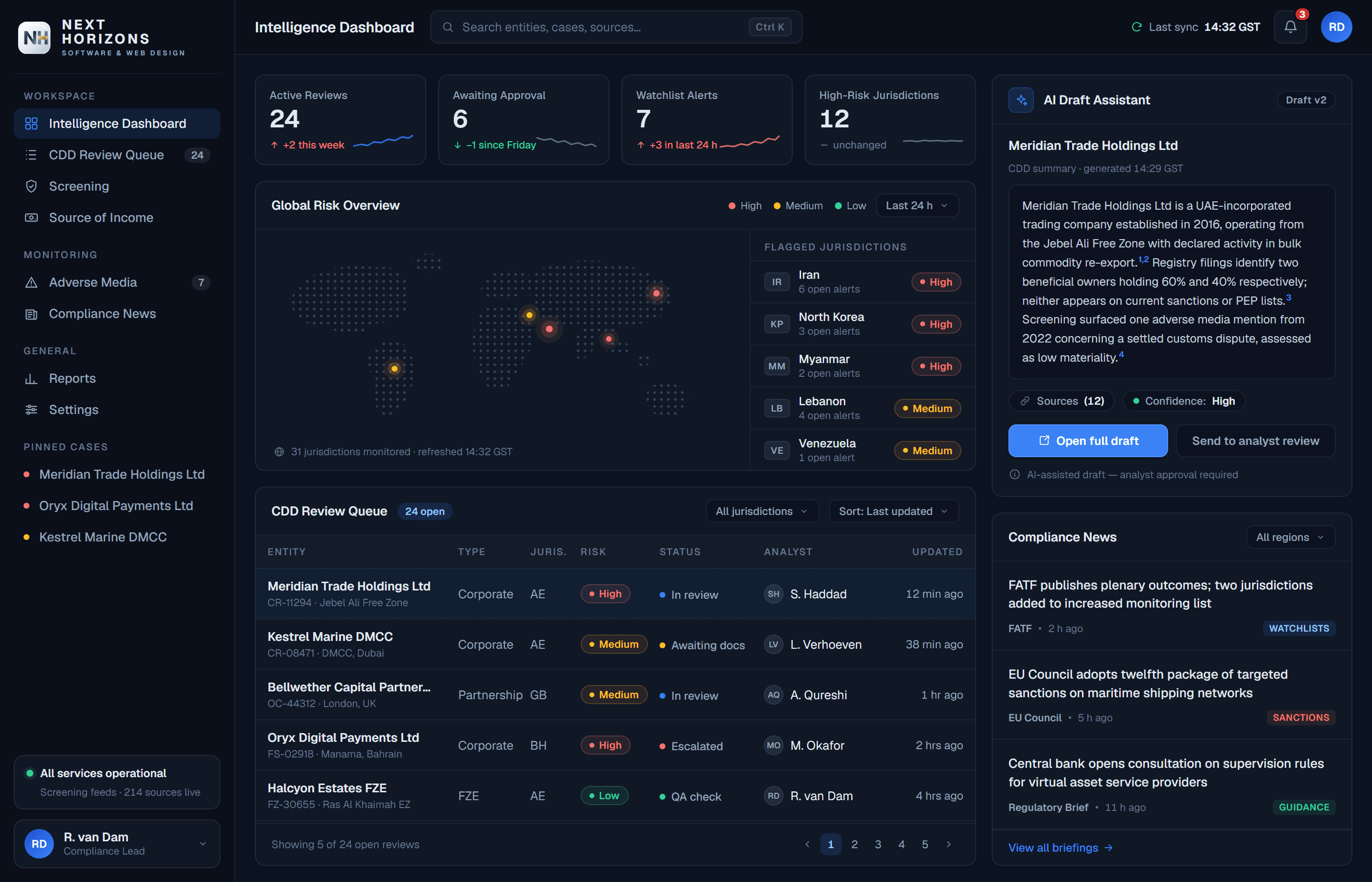
Intelligence Dashboard
See global risk information, high-risk sectors, relevant compliance news and watchlist alerts in one place.
CDD Review Queue
Manage active reviews with the relevant entity, jurisdiction, risk level and review status from one screen.
AI Draft Assistant
Create or improve CDD reviews, summarise findings and prepare structured reports based on the information collected.
Practical Compliance Experience
Developed With Direct Compliance Experience
The direction of the compliance software is led by Rainier van Dam, a CAMS-certified AML and financial crime professional with experience across banking, online gaming and property finance.
His work has included complex CDD and EDD reviews, source of income and source of funds investigations, sanctions, PEP and adverse media screening, quality assurance, procedure development and leading an operational FEC team of approximately 15 analysts.
That practical experience is used when determining which use cases the software supports, how findings are presented and where human review and professional judgement remain necessary.
Who Uses It
Built for Organisations Managing Higher-Risk Reviews
Banks & Credit Institutions
Reduce the amount of manual work involved in CDD and deal with larger review volumes without increasing headcount at the same rate. The software supports structured, traceable reviews that can be aligned with your AML framework.
Asset Managers & Investment Firms
Carry out enhanced due diligence on investors, counterparties and acquisition targets more quickly and consistently.
Compliance & Legal Teams
Let the software handle much of the research and first-draft work, while your professionals focus on investigation, judgement and advisory work.
Fintechs & Payment Providers
Process increasing client volumes without having to grow the compliance team at the same speed.
The Workflow
From Input to a Structured CDD Report
Input Entity
Start with a name, registration number or other identifier. The system uses the available information to identify the correct person or entity.
AI Research
The software performs OSINT research across available sources, including corporate records, media, court information, sanctions sources and beneficial ownership information.
Risk Analysis
The information is brought together and cross-checked. Potential red flags are identified and the findings can be assessed against the risk appetite configured for your organisation.
Report Generated
A structured first-draft CDD report is prepared in the software. This can include source links, confidence information, findings and recommended actions for the analyst to review.
Ongoing Monitoring
Where ongoing monitoring is enabled, reviewed entities remain under monitoring. If relevant new information appears, your team can be alerted.
AI Governance & Model Risk
AI That Can Be Properly Governed
Using AI in a regulated compliance environment creates additional questions around governance, explainability, validation and accountability. We take those requirements into account when the software is designed rather than trying to solve them afterwards.
Human-in-the-Loop by Design
The AI researches, analyses, drafts and flags. It does not make the final compliance decision. Every review remains subject to assessment and approval by a compliance professional. AI makes the process faster; responsibility remains with your organisation.
Explainable & Traceable Output
Important findings include the underlying source and relevant confidence or matching information. That means an analyst can check where the information came from instead of being asked to accept an unexplained AI output.
Model-Risk Management
Models can be documented and version controlled, with the model used for a review logged as part of the process. Behaviour can be tested against known cases and monitored over time, providing information that can support internal model-risk management and audit.
Developed With AI Regulation in Mind
The software is developed with requirements relating to transparency, documentation, human oversight and risk management in mind, including the EU AI Act where it applies. The exact legal and risk classification will depend on how the software is configured and used by your organisation.
Security, Privacy & Compliance
Designed for Regulated Environments
The software is designed for use with sensitive compliance information and can be configured around the regulatory framework that applies to your organisation.
FAQ
Questions We Are Asked
Can the software be configured around our specific requirements?
Yes. Individual modules can be enabled or disabled and we can configure risk thresholds, report templates and screening requirements around your organisation. The software is intended to operate as a standalone application. Any wider integration with existing systems would need to be discussed and scoped separately.
Does our data leave our environment?
The software can be deployed on your own server or private cloud infrastructure, depending on the selected configuration. The exact data flows, model processing and any external services are documented and agreed before implementation. This allows your organisation to assess where client data, documents and reports are processed and stored.
How does the system deal with false positives in sanctions screening?
Potential matches are supported with entity matching and disambiguation information. The software provides the analyst with the available information, rationale and confidence information so potential false positives can be assessed more quickly. The final decision remains with your compliance professional.
Which languages does adverse media screening cover?
Adverse media screening can cover more than 100 languages using AI-assisted translation and relevance analysis. This includes international and regional sources as well as regulatory publications.
Does the AI make compliance decisions itself?
No. The software is AI-assisted rather than autonomous. It researches, drafts, analyses and flags information, but the review is presented to a compliance officer for assessment and sign-off.
How do you address model risk and AI governance?
Models can be documented, version controlled and logged against individual reviews. Outputs retain the information needed to understand how a result was produced, including relevant sources and confidence or matching information. The system can also be monitored and validated over time as part of your own model-risk framework.
Is client data used to train AI models?
No. Client information, documents and reports are not used by Next Horizons to train models. The selected deployment and any external model providers are documented during the scoping process so your organisation can review the applicable data terms before using the software.
How is the tooling priced?
Pricing consists of a monthly component together with pricing based on review volume. The exact amount depends on the functionality, configuration and volumes you require. We agree that during the scoping process rather than offering a standard package that may contain functionality you do not need.
See the Software on a Public Entity of Your Choice
The easiest way to decide whether the software is useful is to see what it actually produces. Book a live demonstration and select a publicly available entity you would like us to review. We will show you how the relevant research, screening and first-draft CDD output can be brought together for your team to assess.
Book Your Demo